Boat tour platforms vs direct bookings in Phuket: what the commission really costs
For Phuket charter and tour owners who want to keep the platforms that fill empty seats and stop paying a cut on guests who already know them.

Platforms take a real cut of a Phuket boat trip. According to the booking-software vendor Magpie, GetYourGuide commission runs 20% to 35%, negotiated with your account manager, with 2 points added if you choose twice-monthly payouts; Viator and Klook are also in the 20% to 35% band. SamBoat states 20% on the rental and 10% on extras paid online in its own terms. That cut is worth paying for a guest who would never have found you, and worth nothing on a guest who already has your WhatsApp number.
What each platform actually takes
Start by writing down the real number for your own account, not the published range. GetYourGuide says on its supplier site that it charges no listing fee, only a commission on fulfilled bookings, that the rate varies by country of operation, and that it is disclosed after sign-up. So the range below is a starting point for a conversation, not your contract.
| Platform | Published commission | Other costs published | Source |
|---|---|---|---|
| GetYourGuide | 20% to 35%, negotiated with the account manager | No listing fee; twice-monthly payouts add 2 points | Magpie (vendor guide) |
| Viator / Tripadvisor | 20% to 35% by experience type and market | 29 USD listing fee per product; "Viator Accelerate" lets you pay a higher rate for better search visibility | Magpie (vendor guide) |
| Klook | 20% to 35%; strongest with Asian travellers | Not published in the same guide | Magpie (vendor guide) |
| SamBoat | 20% on the rental | 10% on extras paid online | SamBoat terms |
Two things in that table decide more than the headline rate.
First, payout timing. On GetYourGuide, asking to be paid twice a month instead of monthly costs 2 commission points. On a 2 million THB year through that one platform, those 2 points are 40,000 THB. That can still be the right trade if your cash is tight in low season, but price it as what it is: a financing cost.
Second, paid visibility. "Viator Accelerate" is a choice to pay more per booking to appear higher. Treat it like an ad budget with a variable rate, and judge it on incremental bookings, not on total bookings.
The calculation, with hypothetical numbers
Here is an example, not a benchmark. Suppose a Phuket speedboat day trip to Phi Phi sells at 4,000 THB per seat, 10 seats sold per trip, 15 trips a month in high season: 600,000 THB a month in gross sales.
Now split that between a platform at 25% and direct bookings.
| Channel | Monthly gross | Commission rate | Commission paid | Kept |
|---|---|---|---|---|
| Platform, 100% of sales | 600,000 THB | 25% | 150,000 THB | 450,000 THB |
| Platform 70%, direct 30% | 420,000 / 180,000 THB | 25% / 0% | 105,000 THB | 495,000 THB |
| Platform 50%, direct 50% | 300,000 / 300,000 THB | 25% / 0% | 75,000 THB | 450,000 + 225,000 THB |
In that example, moving 30% of the volume to direct keeps 45,000 THB a month that was going to commission. Over a six-month high season, 270,000 THB. That is the size of the prize, and it is also the honest ceiling: direct bookings are not free. Your own costs are card fees, the time someone spends answering WhatsApp, and whatever you spend on being findable.
Run the same table with your own numbers before you change anything. Three inputs: your average sale per booking, your real commission rate per platform, and the share of last month's bookings that came from each source. If you cannot produce that third number, that is the first job, not the calculation.
Measure your channel mix first
Do this for last month, on one sheet:
- Export bookings from each platform's extranet (GetYourGuide, Viator, Klook, SamBoat).
- Count your direct bookings: WhatsApp threads, LINE messages, phone calls, your website form, walk-ups at the pier.
- Count hotel and tour-desk bookings separately, with the commission you actually pay them.
- For each source, write gross sales, commission paid, and net.
- Mark every booking that was a repeat guest or a referral from a past guest.
That last line is the one that matters for the rest of this article. A repeat guest booking through a platform is commission you are paying on a relationship you already own.
When the commission is worth paying
Keep the platforms where they do work you cannot do. Three cases are clear.
Nationalities you do not reach yourself. Russians were the top nationality visiting Phuket in the first half of 2026 with 583,041 arrivals, then Indians (326,906) and Chinese (322,315), according to CBRE Thailand. If your website and your crew work in English only, Klook's strength with Asian travellers (per the Magpie guide) is buying you something real.
Low season and gap-filling. Phuket's demand swings hard: January and February are 43% of first-half air arrivals and June only 11%, with hotel occupancy going from 92% in January to 67% in June, according to Knight Frank. Add the Similan and Surin national park closure every monsoon, 16 May to 14 October in 2025 per the Government Public Relations Department. A 25% commission on a seat that would have sailed empty costs you nothing but the fuel you were burning anyway.
First-time discovery. A traveller comparing six Phi Phi operators on one screen is doing research you are not in. Paying to be one of the six is reasonable.
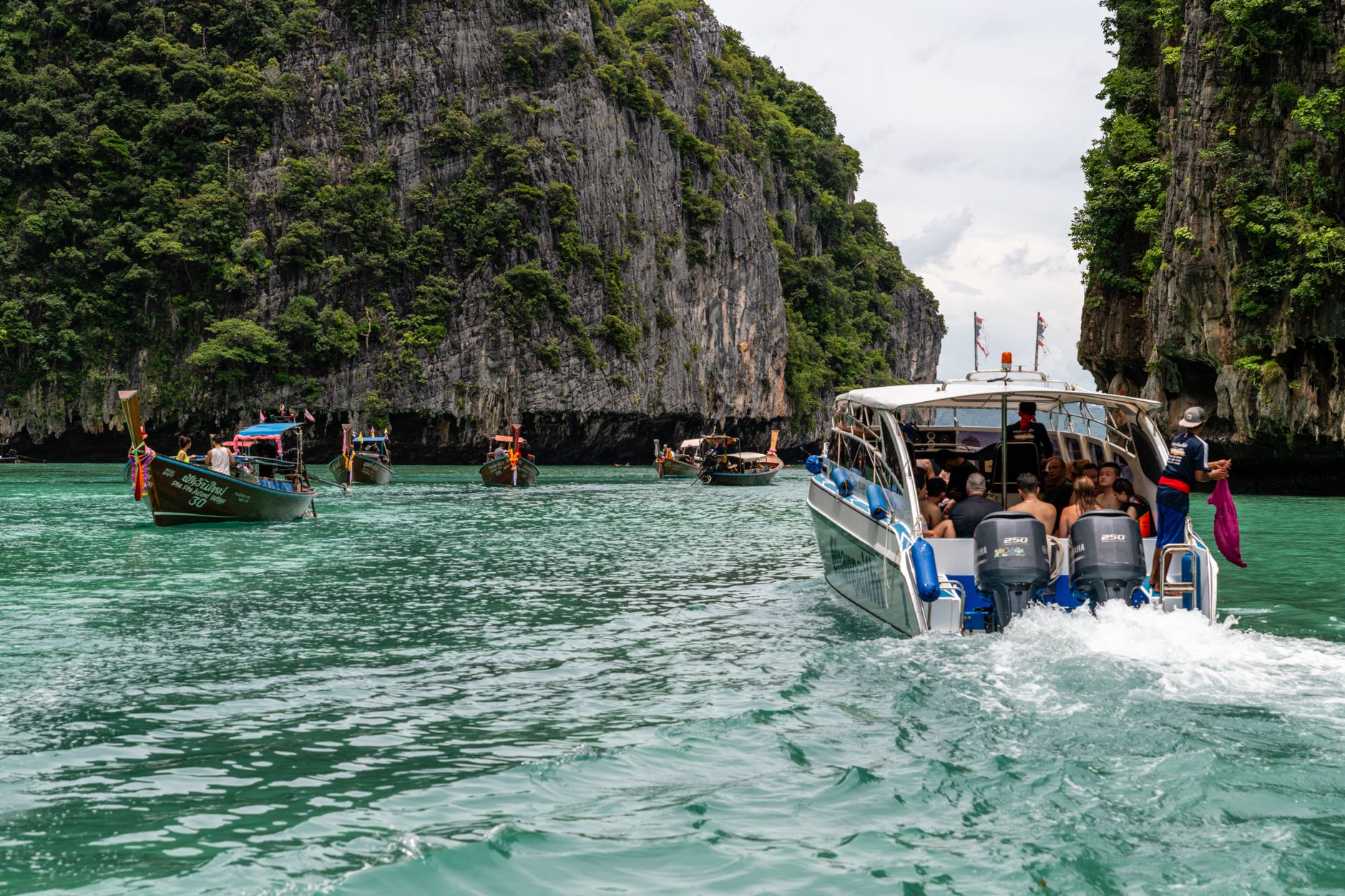
Here is what moving to direct will not fix. It will not fix a boat that leaves late, a crew that does not speak the guest's language, or photos that show an empty deck. Platforms expose those problems through reviews; direct bookings just hide them from you. And it will not replace discovery volume in your first season. Cutting platforms before you have a direct channel is how operators lose a high season.
Moving repeat and referred guests to direct, without breaking the rules
The line is simple and worth respecting: do not use a platform's booking data to pull that guest off the platform, and do not undercut platform prices in a way your contract forbids. Read your own agreement on rate parity and on contacting customers, and if a clause is unclear, ask your account manager in writing. What follows works on the guest's own behaviour after the trip, not on the platform's data.
- Make the boat itself the channel. A printed card in every guest's hand at the end of the trip, with a QR code to your WhatsApp or LINE, in English, Russian and Chinese. One line: "Book your next trip directly with the captain." That is a physical handover to a person standing in front of you, not an extraction from a platform database.
- Put the number where guests already look. Your Google Business Profile should carry your WhatsApp or LINE in the description and as a link, with photos from this season. Our guide on getting a charter found on Google Maps covers the profile work in detail.
- Be answerable on the apps your guests use. LINE has 56 million monthly active users in Thailand, 82.6% of Thai internet users, per DataReportal, and business use of WhatsApp in Thailand grew 208% in 2024 according to The Nation. Russian guests will often ask for Telegram. Have all three, with someone who replies.
- Collect the WhatsApp number at the pier, not from the extranet. Ask for it in person for the trip itself (weather changes, pickup times, the photo album). Then you have a contact the guest gave you directly, with a reason.
- Send the photos. Your crew already takes them. Sending the album by WhatsApp or LINE the same evening is the cheapest reason to be in the guest's phone, and the easiest message to forward to a friend.
- Give referrers something to send. A short page per trip on your own site, priced, bookable, in the guest's language. People forward links, not platform search results.
- Make walk-ups easy. A survey of 2,550 US and European travellers in Q4 2025 (Arival and Phocuswright, reported by Hotel Online) found fewer than half booked their most recent tour, activity or attraction online, and nearly one in five travellers under 55 simply walked up to the provider. A readable sign at Chalong or Ao Po with a QR code is a direct channel.
On pricing: the safe version of a direct incentive is something a platform cannot sell, not a lower price. Free pickup from Patong or Kata, an extra hour at anchor, a longer snorkel stop, drinks included. That keeps rate parity intact and still gives the guest a reason to book with you.
Where direct guests will actually find you
Direct does not mean waiting. It means being present where the search happens.
- Google Maps and Google Business Profile, in high season especially, for guests already in Rawai, Chalong or Bang Tao looking for a boat tomorrow.
- AI answers. ChatGPT reached 800 million weekly active users in October 2025 per TechCrunch, and Google AI Mode passed 1 billion monthly active users by July 2026 according to Google's Q2 2026 earnings remarks. An HSMAI Asia presentation notes that an AI answer about where to stay typically cites only one or two options. Being the cited operator matters more than being the fiftieth listing.
- The platform each nationality uses. For Chinese guests, a Prince of Songkla University study in 2025 found Xiaohongshu (RED) the most influential channel for Chinese tourists in Phuket, at 4.09 out of 5, then Douyin. Russian guests use Yandex Maps.
- Your own pages, in five languages. Not a translated homepage: a page per trip, per language, with the price and a WhatsApp button.
Notorioos works on exactly this layer for Phuket charters and tour operators: Google Maps, AI answers, SEO, ads, and the platform each nationality uses, in English, Thai, Russian, Chinese and French, with the inquiries going straight to you.
One licensing note
If you sell trips as a tour business, licensing is not optional. Thai tour businesses need a licence from the Department of Tourism and a security deposit by category. The Nation reported current amounts and an August 2026 proposal: specific-area 3,000 to 10,000 THB; domestic 15,000 to 50,000; inbound 30,000 to 100,000; general 60,000 to 200,000, with public consultation from 17 August to 30 September 2026 and a one-year grace period for existing operators once enacted. Moving volume to direct puts more of the transaction in your name, so check your category with a Thai lawyer rather than assuming the platform covered you.
Do this week
Build the one-page channel mix for last month: gross sales, commission paid and net for each platform, your direct bookings, and a mark on every repeat or referred booking. Then print the card that goes into every guest's hand at the end of the trip, with a QR code to your WhatsApp and LINE. Those two things cost almost nothing and tell you whether the commission you pay is buying discovery or just collecting rent on guests you already have.
If you want to see where you stand before changing anything, Notorioos offers a free Visibility Check that shows where the charter appears on Google Maps and in AI answers in five languages.
Questions
How much commission does GetYourGuide charge a Phuket boat operator?
GetYourGuide says on its supplier site that it charges no listing fee, only a commission on fulfilled bookings, and that the rate varies by country of operation and is disclosed after sign-up. The booking-software vendor Magpie puts the range at 20% to 35%, negotiated with your account manager, with 2 points added if you choose twice-monthly payouts instead of monthly. Your own rate is in your contract, so check it there rather than relying on a published range.
Can I ask a GetYourGuide or Viator guest to book directly next time?
Read your own supplier agreement first, because the clauses on contacting customers and on rate parity differ by platform and by contract. What is safe in practice is working on the guest's own behaviour after the trip: a card handed over in person at the end of the day, a number the guest gives you directly at the pier, photos sent by WhatsApp or LINE. Using platform booking data to pull a guest off the platform, or undercutting platform prices where your contract forbids it, is where operators get into trouble. If a clause is unclear, ask your account manager in writing.
Is it worth keeping OTAs and tour platforms at all if direct bookings cost nothing?
Yes, in three cases: nationalities you cannot reach in their own language, low season and the monsoon months when seats would sail empty anyway, and first-time travellers comparing operators who have never heard of you. Phuket demand is very uneven, with January and February accounting for 43% of first-half air arrivals and June only 11% according to Knight Frank. A commission on a seat you would not otherwise have sold is cheaper than an empty seat.
How do I know how many of my boat bookings are already direct?
Export last month's bookings from each platform extranet, then count your direct bookings by source: WhatsApp, LINE, phone, website form and walk-ups at the pier. Put hotel and tour-desk bookings in their own line with the commission you actually pay them. Then mark every booking that came from a repeat guest or a referral. That last number tells you how much commission you are paying on relationships you already have.

Axel Joseph Auguste co-founded Notorioos. He builds the tools the agency uses to measure where a business appears on Google Maps and in AI answers such as ChatGPT and Google AI Overviews, for real estate agencies, hotels, boat charters and restaurants in Phuket. Before Notorioos, he built Bilan de Compétences, a software platform for career assessment consultants in France.